Ilyas Baqa
Media Art · Technosomatics · Code · Berlin

Ilyas
Baqa

Ilyas Tuğan Anlıak

Transdisciplinary media artist and engineer. Biosensing, kinetics, movement and code, working at the limits of translating intimate bodily states.

v = 2.41 m/s threshold
Fig. 01 / Membrane under load
01 / Artist Statement

Ilyas Baqa (Ilyas Tuğan Anlıak) is a transdisciplinary media artist and engineer working at the intersection of technosomatics, biosensing, kinetics, movement and code.

His artistic work was set in motion by an encounter: so brief, yet so meaningful that it has resonated far beyond its duration, as Rumi describes in his writings. The other held up a mirror in which hidden parts of himself surfaced. From this explosive, transformative energy grew the desire to carry the untranslatable outward. Since then, his works have also served as a medium of translation for the communication that failed in that encounter.

Grounded in a personal somatic transformation biography and trained in engineering and psychophysiological research, his practice investigates the limits of translating intimate, vegetative and affective bodily states. Working with real-time biosensors (GSR, EMG, HRV), industrial pneumatics, soft robotics and algorithmic motion analysis, he creates spaces for trans* embodiment and emotional resonance.

Works

02 / Selection
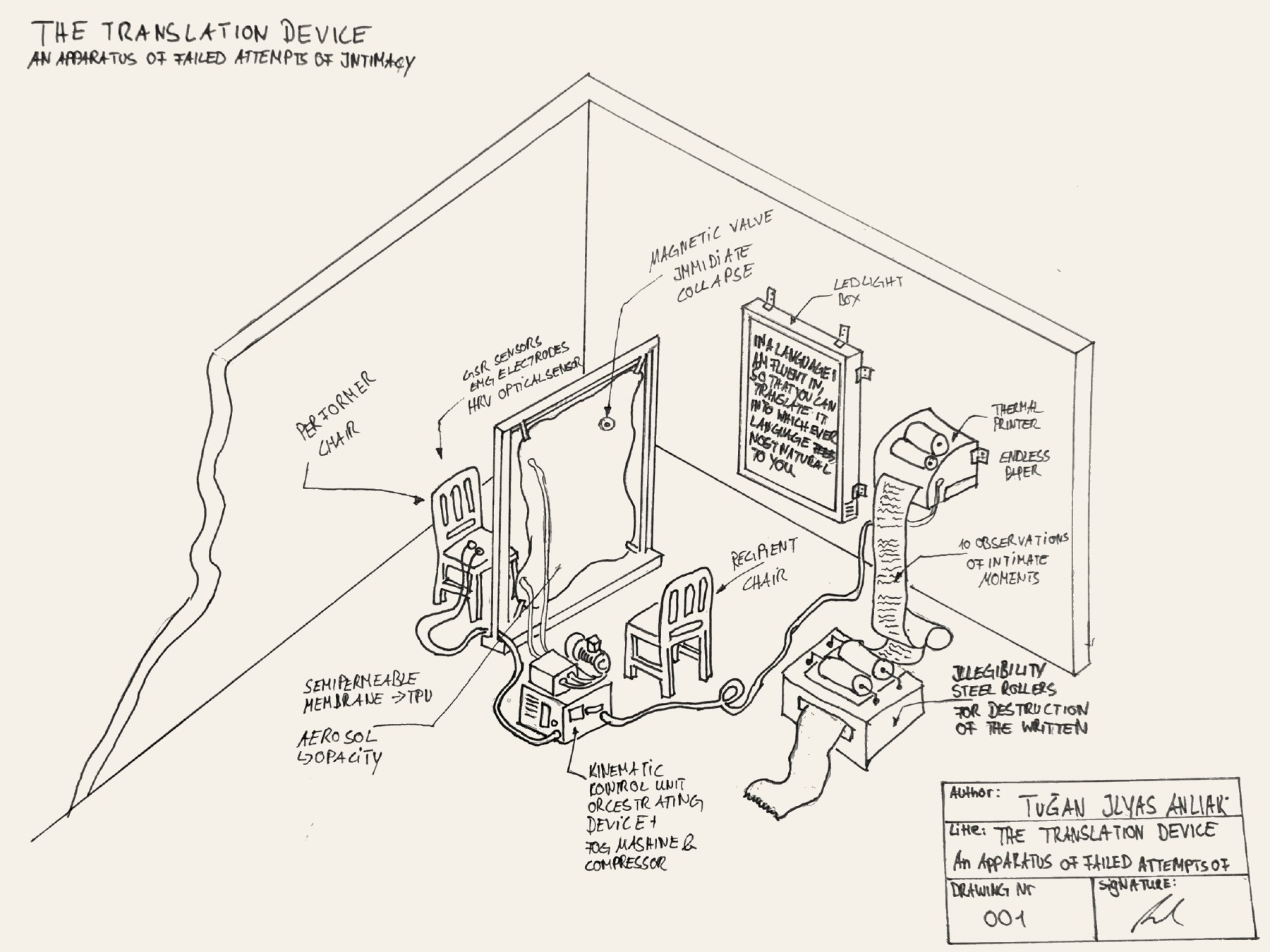
Isometric hand drawing of the installation: performer chair with sensors, membrane in a frame with magnetic valve, recipient chair, control unit with fog machine and compressor, LED light box, thermal printer with endless paper and steel rollers
Drawing No. 001 / isometric hand drawing, concept
Concept · Kinetic spatial installation & biosensing performance

The Translation Device
An Attempt at Failed Intimacy

Two chairs, a membrane between them. Only the performer is connected to the apparatus via sensors (GSR, EMG, HRV); the translation runs in one direction. Bodily states stretch a TPU membrane in a steel frame, a magnetic valve makes it collapse abruptly, fog clouds the view.

A thermal printer writes observations of intimate moments onto endless paper; steel rollers render the writing illegible again. The recipient sees the tension but cannot answer.

Material
TPU membrane (recyclable), steel frame
Technology
Biosensing, pneumatics & magnetic valve, fog machine, thermal printing, roller mechanism
Status: Concept

The work exists as a concept, a drawing and first feasibility prototypes; it has not yet been realised as an installation and has not received any funding to date. Its realisation (membrane frame, pneumatics, biosensing, printing and roller mechanics) requires substantial production funds.
The Translation Device / feasibility prototypes
Studio tests, Berlin

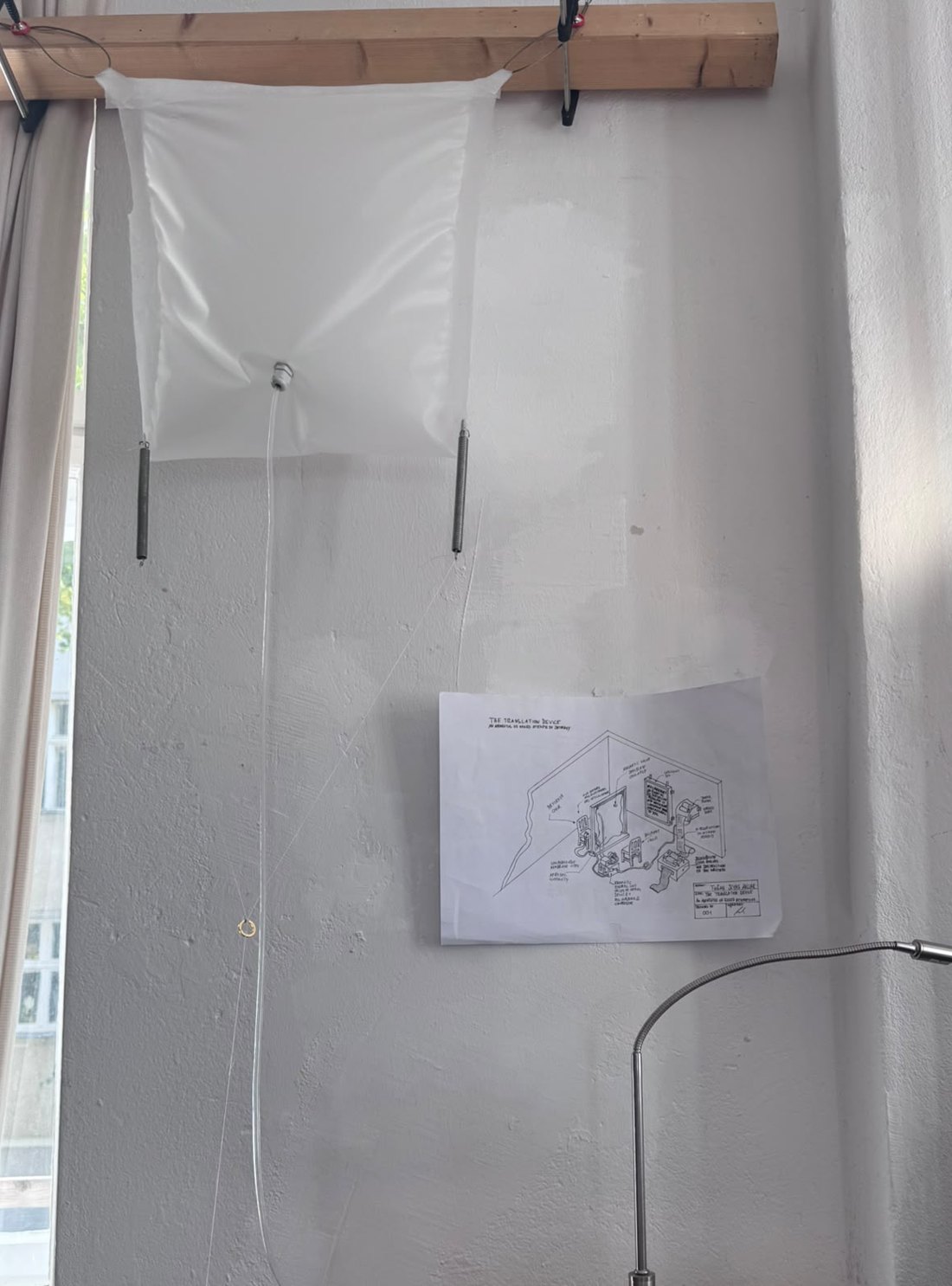
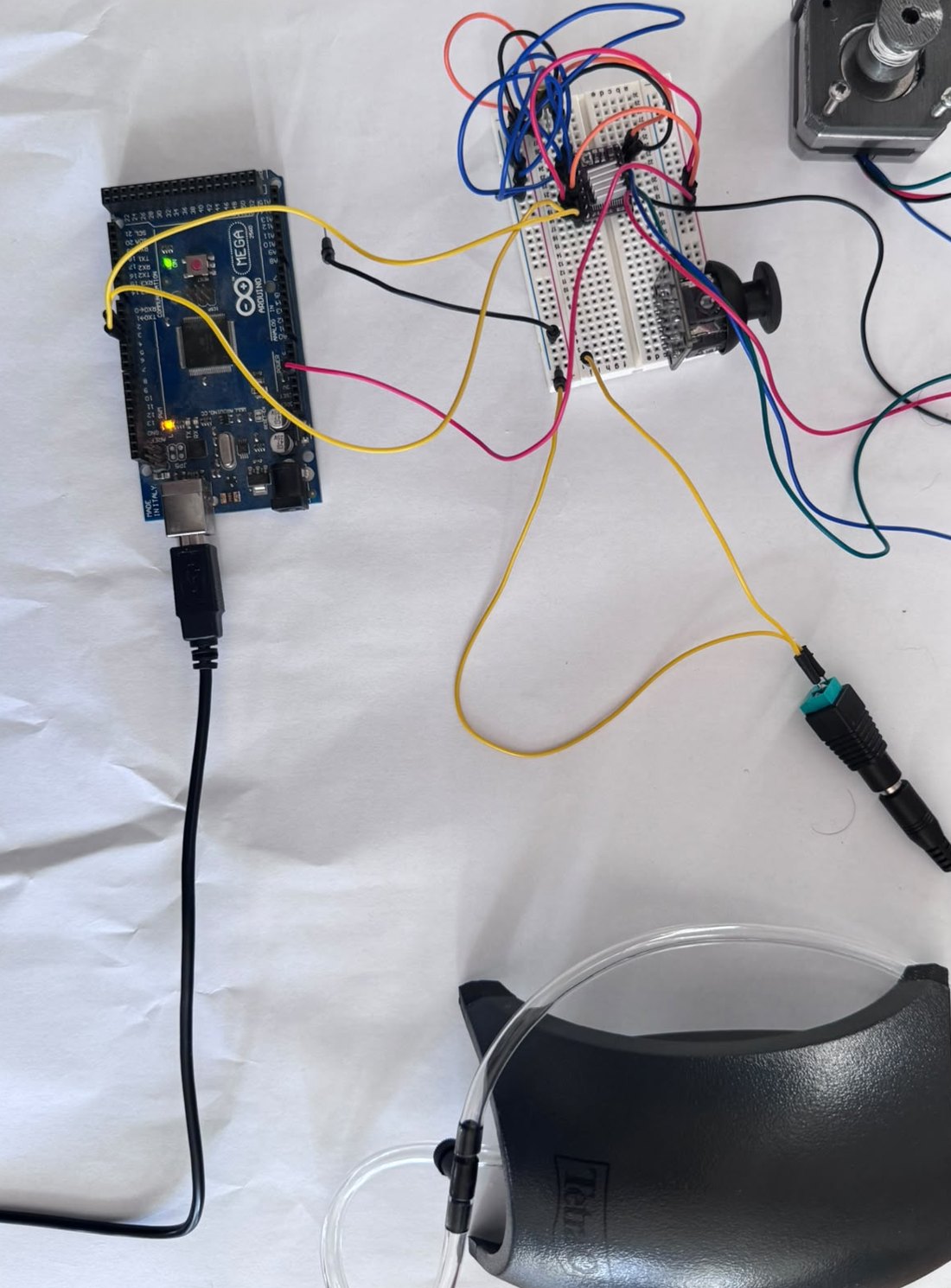
Prototypical membranes, driven by a microcontroller, an air pump and a stepper-motor cable winch, were built to explore which parts of the concept are technically feasible: inflation, tension and release of the membrane.

Prototype membrane suspended from a wooden beam on springs, with an air inlet at its centre; the isometric drawing hangs on the wall beside it
Prototype membrane on springs, air inlet at the centre
Control prototype on white paper: Arduino Mega, breadboard with stepper driver, stepper motor with cable winch and an air pump
Control unit: microcontroller, stepper cable winch, air pump
2026 · Motion analysis · Python / MediaPipe

Algorithmic Somatics & Collapse Analyses

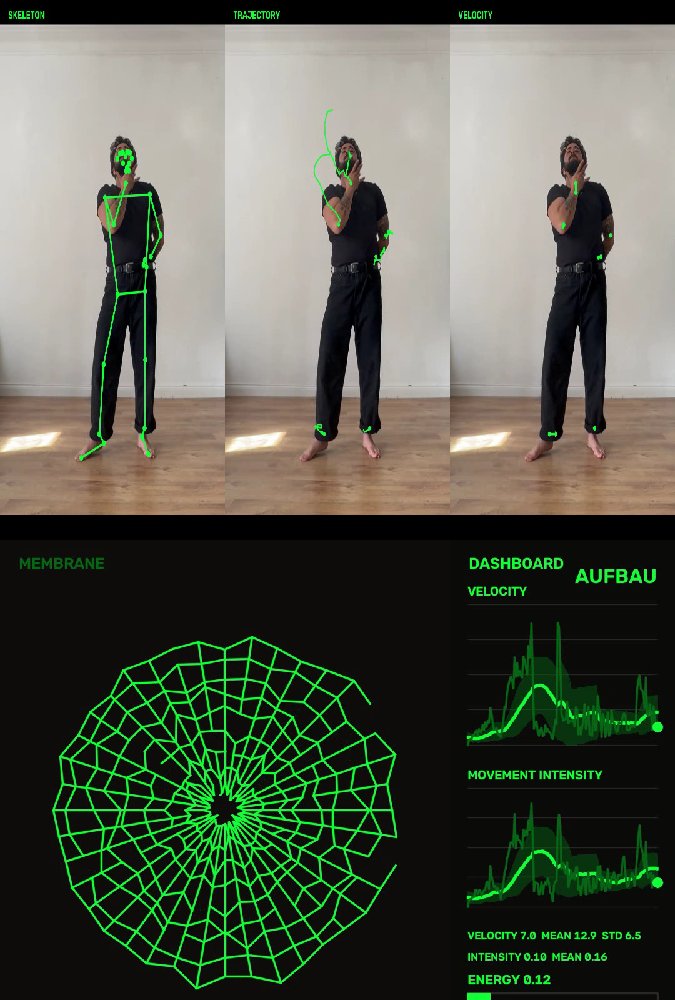
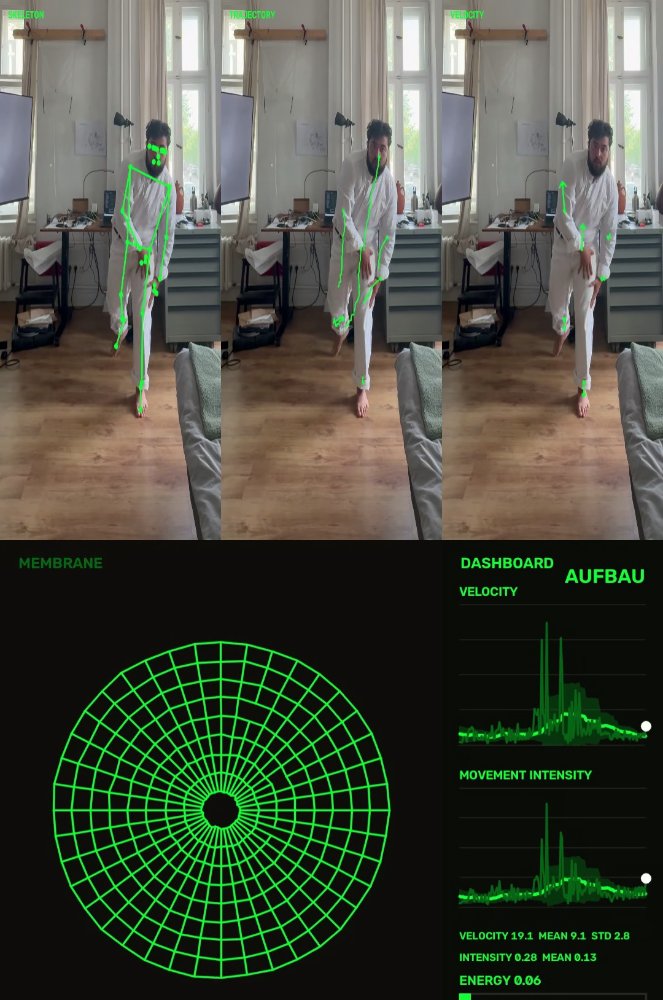
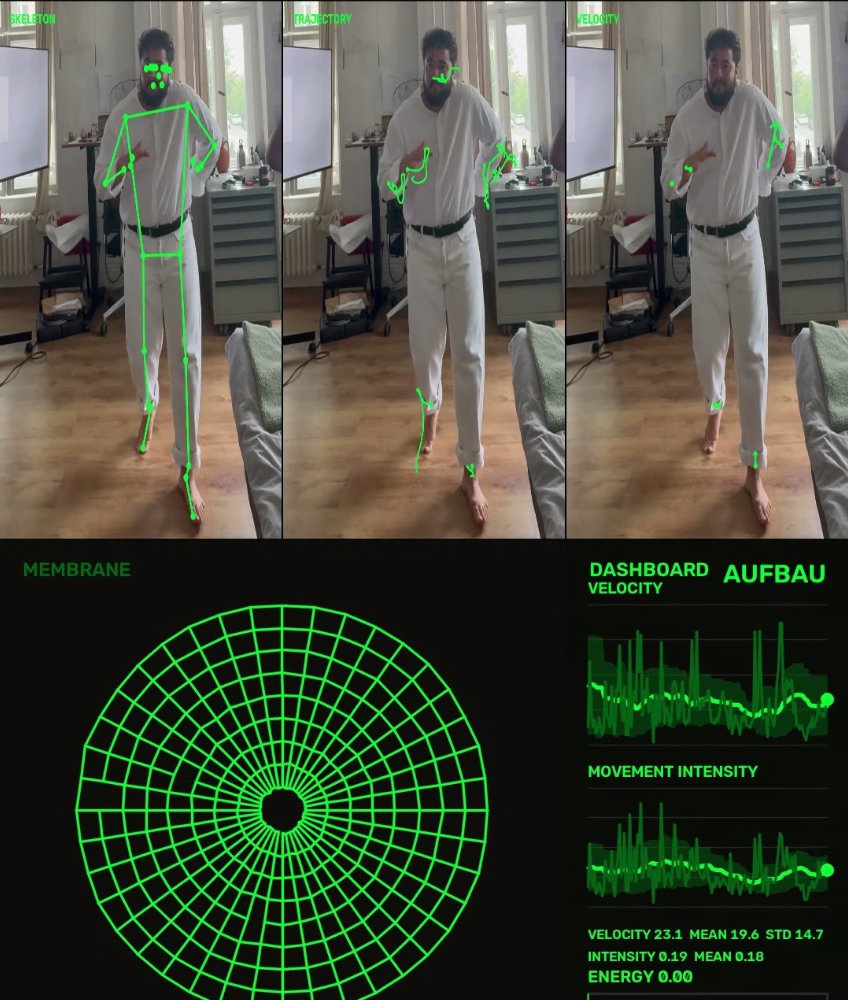
Interactive motion analyses, landmark networks, dance and code performances. Velocities and trajectories are computed from the landmarks of the artist's own dance; when they exceed set thresholds, a simulated membrane begins to give way until it collapses.

Pipeline: video → MediaPipe skeleton → velocity analysis → thresholds → collapse simulation.

→ Study: Zahr & Tiryāq
Kır Zincirlerini, 2026. Dance and landmark analysis, studio, Berlin. Music: Tarkan. Instagram ↗
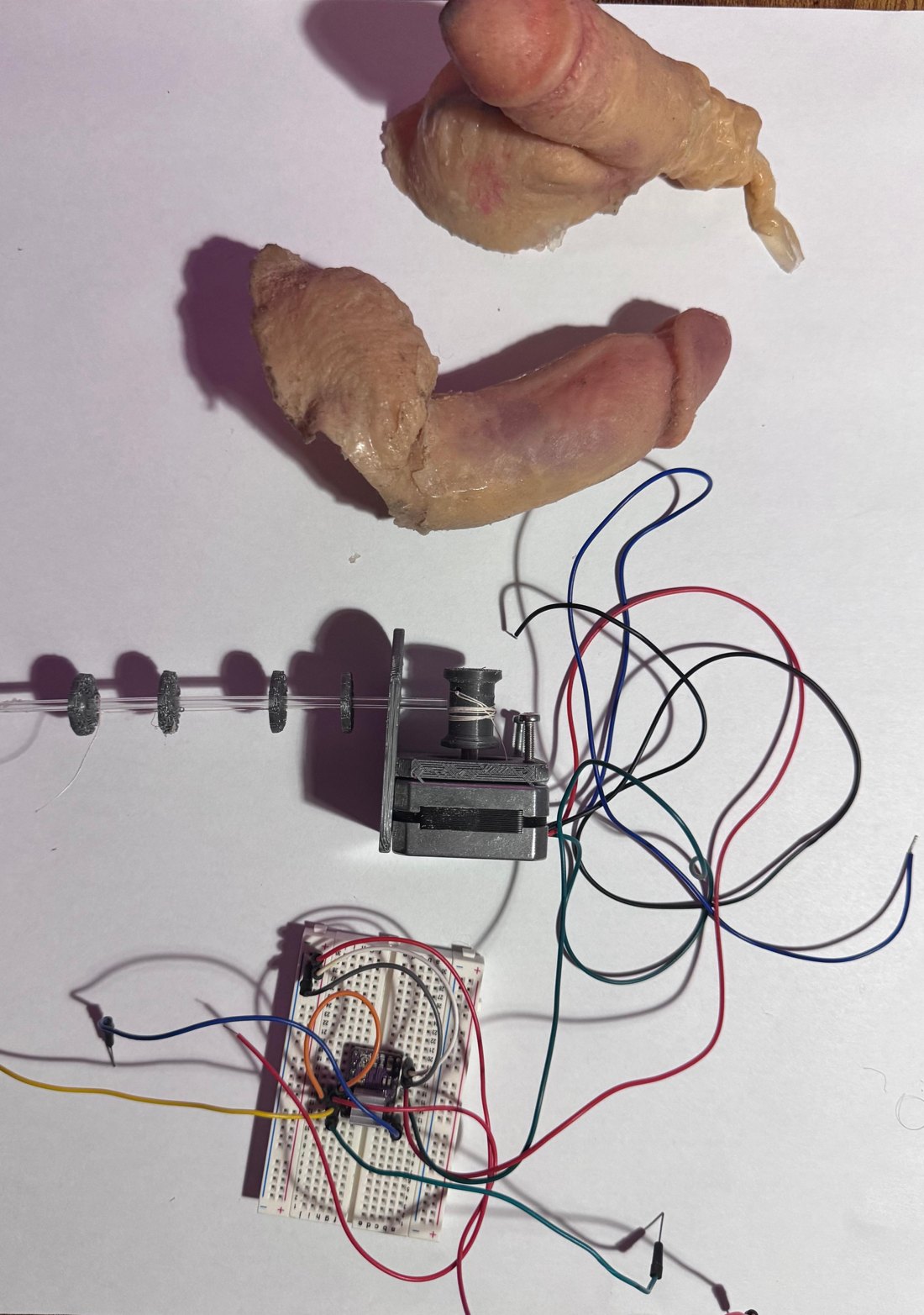
Penile Transplant: two hand-cast silicone bodies above a cable-driven segmented mechanism with stepper motor and breadboard electronics
2022 · Kinetic object · Soft robotics

Penile Transplant

A failed attempt at bionic extension. The desire: to capture one's own states of arousal and translate them into erectile movement. The capturing never came about; the mechanical elaboration of the erection had already failed under its own scope.

What remains are two hand-cast silicone bodies and a cable-driven mechanism that never moved them. Here, as in much of the practice, failure is not a residue but part of the work.

Material
Silicone casts, handmade, pigmented; PLA (3D print)
Technology
Cable-driven actuator, stepper motor, driver electronics
Study · Algorithmic Somatics

Zahr & Tiryāq

Poison and antidote: a paradox of Rumi, read through movement data
Persian original

همچو زهر و هم چو تریاقی که دید؟
همچو دمساز و مشتاقی که دید؟

Turkish

Hem zehir hem de panzehir olan bir şeyi kim görmüştür?
Hem yâr, sohbet arkadaşı, hem de özlemle tutuşan birini kim görmüştür?

English

Who has ever seen something that is both poison and antidote?
Who has ever seen one who is both companion and longing lover?

Rumi, Masnavi, Book I, verse 11 / zahr o tiryāq, zehir ve panzehir, poison and antidote
threshold 0.5 P0 (210, 168) r ≈ 184 360 410 CL grid 40 · units px
Fig. 02 / Iznik tulip medallion, construction drawing after a tile in the Rüstem Pasha Mosque, Istanbul

In his mysticism Rumi turns the motif around: the transforming love of the beloved acts on the ego, the nafs, like a destroying poison, zahr; yet it is at the same time the only saving antidote, tiryāq, for the awakening soul.

The study transfers this paradox to dance. The state KOLLAPS is the poison: destructive, sudden, brief. The state AUFBAU (build-up) is the antidote: healing, but slow. Both arise from the same underlying energy signal, just as poison and antidote are the same substance in the verse.

The asymmetry is built into the code on purpose: a moment of intense movement adds energy four times faster than a calm moment drains it. The question is what the body then does with that rule.

Poison · energy gain
+0.06 per spike frame
Antidote · energy decay
−0.015 per calm frame
Method
  1. 01A two-minute dance is filmed; MediaPipe extracts the body landmarks frame by frame.
  2. 02The velocity of the landmarks is computed for every frame.
  3. 03Spike frames raise the energy value collapse_value by 0.06; calm frames lower it by 0.015.
  4. 04Above the threshold of 0.5 the membrane is in KOLLAPS; below it, in AUFBAU.
  5. 05Episodes of both states are counted and their mean duration measured.
4×

faster acts the poison; set by design in the code

6.5

frames: mean duration of a collapse (4 episodes)

703.2

frames: mean duration of a build-up (5 episodes)

108×

longer lasts the healing; measured in the dance

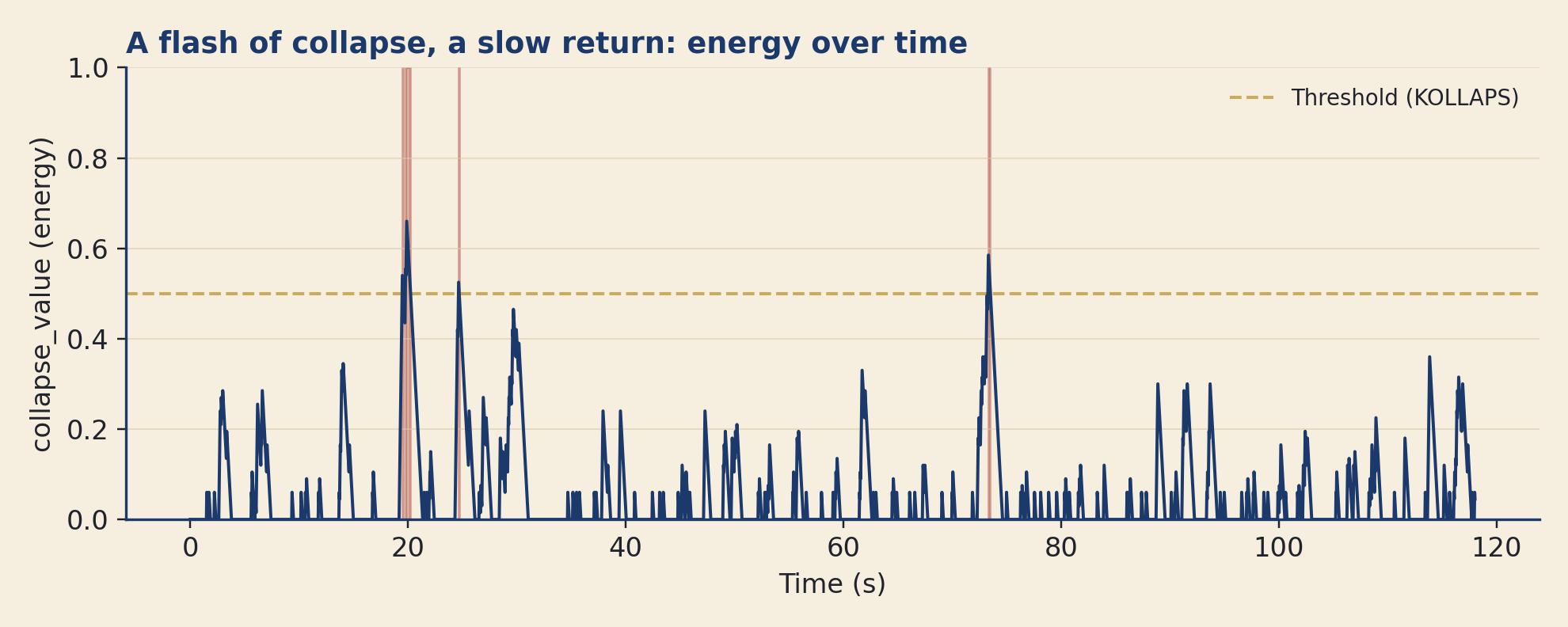
Chart: collapse energy over 120 seconds of dance; three brief spikes exceed the threshold of 0.5
Fig. 03 / A flash of collapse, a slow return: energy over 120 s of dance

Reading the curve

Across two minutes, the energy crosses the threshold only in a few short flashes, around 20, 25 and 73 seconds. The rest of the dance is spent below it, slowly rebuilding.

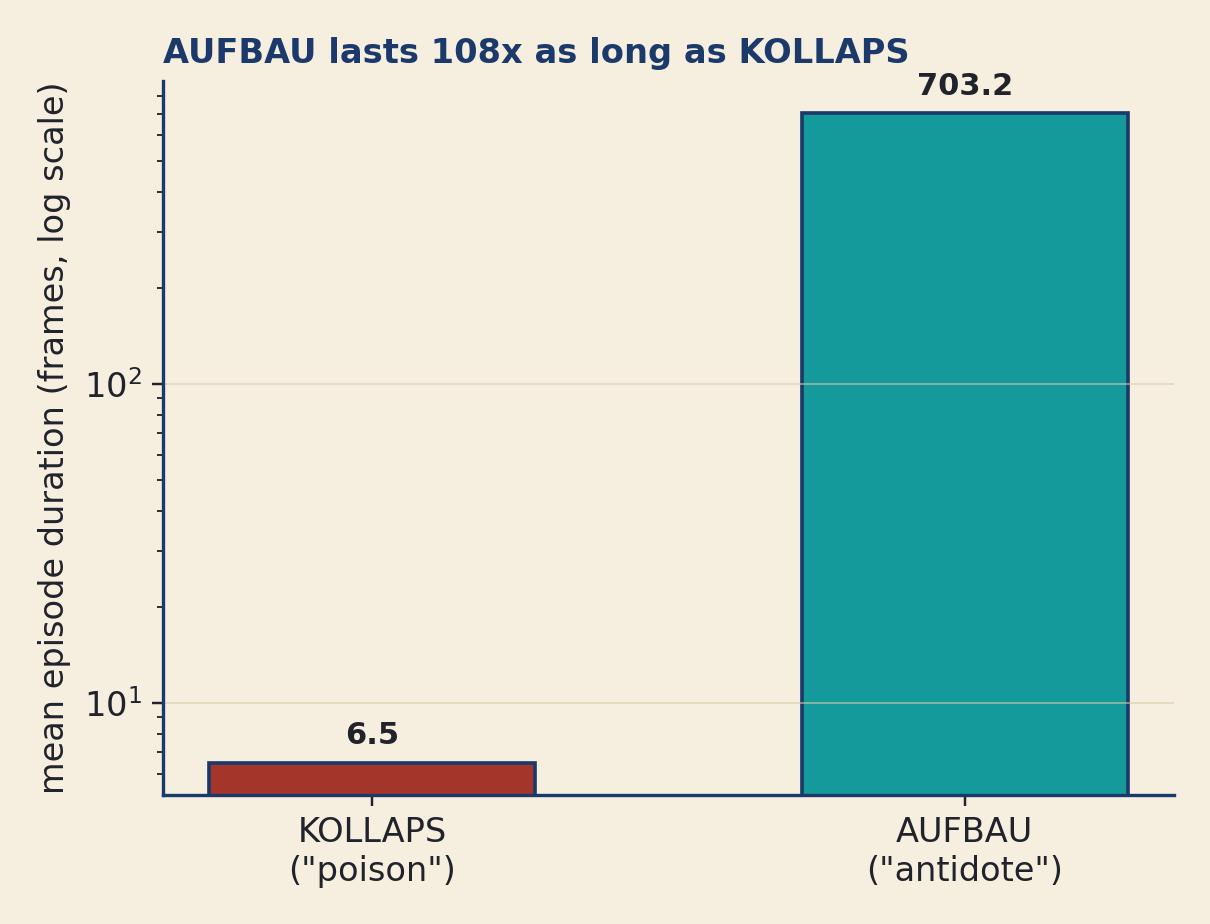
Bar chart on a log scale: collapse 6.5 frames, build-up 703.2 frames
Fig. 04 / Mean episode duration, log scale

Why 108 and not 4?

The factor of 108 is far larger than the factor of 4 wired into the code between rise and decay. The effect compounds over many frames: falling back below the threshold requires the energy to be drained slowly across very many calm frames, while a single intense spike is enough to drive it back up quickly.

Conclusion

Poetically and numerically consistent: destruction is fast, healing is slow.

The ratio can be stated cleanly (4× by design / 108× in the body), and it matches the feeling of the verse. Perhaps no coincidence, but a reminder that feedback systems with asymmetric rise and decay, here deliberately programmed, are a recurring pattern in nature as much as in art.

Movement Studies

03 / Dance performances
Bir Anda, 2026. Studio, Berlin. Music: Mustafa Sandal. Instagram ↗
İki Tas Çorba, 2026. Studio, Berlin. Music: Mustafa Sandal. Instagram ↗

CV

Media artist and engineer (M.Sc. Human Factors, M.Sc. Mechanical Engineering), Berlin.

Kinetic art & soft robotics · Biosensing (GSR, EMG, HRV) · Technosomatics & trans* embodiment · Algorithmic motion analysis (MediaPipe, Python) · Industrial pneumatics & mechatronics

Artistic practice
2026The Translation Device: An Attempt at Failed IntimacyKinetic spatial installation & biosensing performance; concept and feasibility prototypes, not yet realised
2026Algorithmic Somatics & Collapse AnalysesInteractive motion capture, landmark networks, dance & code performances
2022–2023Reshape matterGrant-funded community build project for trans* & BIPOC empowerment, Kulturformen Berlin
2022Penile TransplantKinetic object, silicone casts & cable mechanics
Education & research
since 2025M.Sc. Human Factors, Technische Universität BerlinPsychophysiology, biosensing, human-machine interaction & ergonomics
2017–2022M.Sc. Mechanical Engineering (Design Engineering), Berliner Hochschule für TechnikKinetics, mechatronics, bionics & modelling
2012–2016B.Eng. Mechanical Engineering, Düsseldorf University of Applied SciencesProduct development & engineering mechanics